
Today we will see how to convert mixed numbers to improper fractions and improper fractions to mixed numbers. We’ve prepared a few examples, it’s a piece of cake.
Content
- Example 1
- Steps for writing a mixed number as an improper fraction
- Example 2
- Steps for writing an improper fraction as a mixed number
- Example 3
- Example 4
- Video
- References
Before seeing the examples, just remember that an improper fraction is a fraction where the numerator is greater than or equal to the denominator. Also, a mixed number contains a whole number and a fraction.
1) Rewrite 21/4 as an improper fraction
First, to find the numerator of the improper fraction, we multiply the denominator (4) by the whole number (2), then we add the result to the numerator (3). Finally, we keep the denominator (4) the same.

The mixed number 21/4 is equivalent to the improper fraction 11/4.
Steps for writing a mixed number as an improper fraction
To convert from a mixed number into an improper fraction, follow these steps:
- Multiply the denominator by the whole number.
- Add this result to the numerator.
- Keep the denominator the same.
2) Rewrite 32/5 as an improper fraction
First, we need to find the numerator of the improper fraction, so we multiply the denominator (5) by the whole number (3), then we add this result to the numerator (2). Finally, the denominator (5) stays the same.
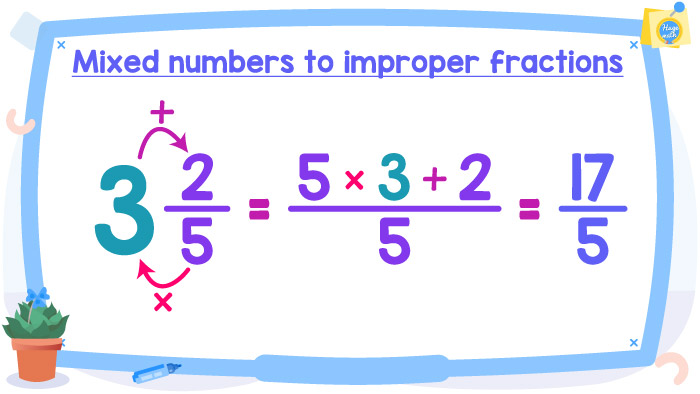
We can also get the answer graphically. First, we need to model our mixed number 32/5, as shown in the image below. Finally, we just need to count how many fifths we have in the model. As you can see, we took seventeen fifths, and that is the improper fraction we are looking for.

Steps for writing an improper fraction as a mixed number
To write an improper fraction as a mixed number, follow these steps:
- Divide the numerator by the denominator.
- The quotient is the whole number part of the mixed number.
- The remainder over the original denominator is the fractional part of the mixed number.

3) Rewrite 9/4 as a mixed number
To convert this improper fraction, first, we divide the numerator 9 by the denominator 4. Then, the quotient (2) of this division is the whole number part of the mixed number. Finally, we write the remainder (1) over the original denominator (4) to get the fractional part of the mixed number.
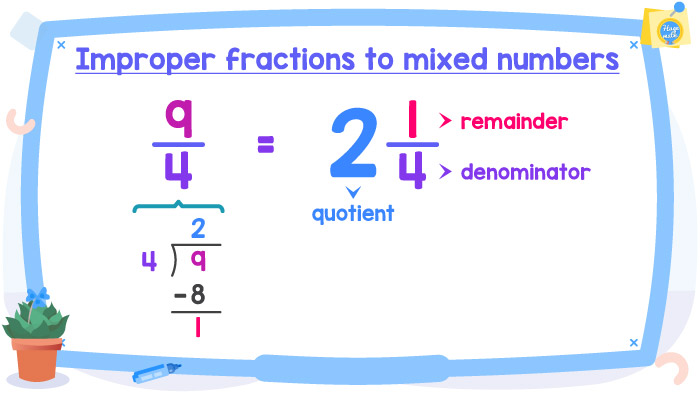
The improper fraction 9/4 is equivalent to the mixed number 21/4.
4) Rewrite 17/5 as a mixed number
To write the improper fraction 17/5 as a mixed number, first, we divide the numerator 17 by the denominator 5. The quotient (3) of this division is the whole number part of the mixed number. Finally, the remainder (2) of this division over the original denominator (5) is the fractional part of the mixed number.

We can also use a graphical method to do this conversion. First, we model the fraction 17/5. In this diagram 1 circle represents 1 whole (see the image below). Then, we have 3 whole circles and 2/5 of the last circle, therefore, we have 3 wholes and 2/5 or just 32/5.

In that way, 17/5 is equivalent to the mixed number 32/5.
Video
In the following video, we will see more examples.

In this post you will find more examples of how to convert a mixed number to an improper fraction and an improper fraction to a mixed number.
References
For this lesson, we have used these references:
- Tussy, K., Gustafson, D. y Koenig, D. (2013). Prealgebra (4th ed.; pp. 361-363). Cengage Learning.
- Martin-Gay, E. (2020). Basic college mathematics with early integers (4th ed.; pp. 245-246). Pearson.