
In this lesson, we will see how to add mixed numbers, whole numbers, and fractions. It’s easy, let’s take a look at the examples.
Content:
Before we see the examples, recall that a proper fraction is a fraction where the numerator (the top number) is less than the denominator (the bottom number). Also, a mixed number is the sum of a whole number and a proper fraction. See the image below.

1) Add 3 + 21/4 + 2/3
To find the sum of these numbers, first, we add the whole number (3) with whole number part of the mixed number (2).

Then, we add the fractional part of the mixed number (1/4) and the fraction (2/3).

Finally, we add the sum of the fractions (11/12) to the sum of the whole numbers (5).

If you want to, you can convert the resulting mixed number to an improper fraction.

Steps for adding mixed numbers, whole numbers, and fractions
For adding mixed numbers (mixed fractions), whole numbers and fractions, just follow these simple steps:
- Add the whole numbers with the whole number parts of the mixed numbers.
- Add the fractions with the fractional parts of the mixed numbers.
- Add the sum of the fractions to the sum of the whole numbers.
2) Add 2 + 3/5 + 7 + 31/2
We start by adding the whole number and the whole number part of the mixed number.

We continue by adding the fraction and the fractional part of the mixed number.
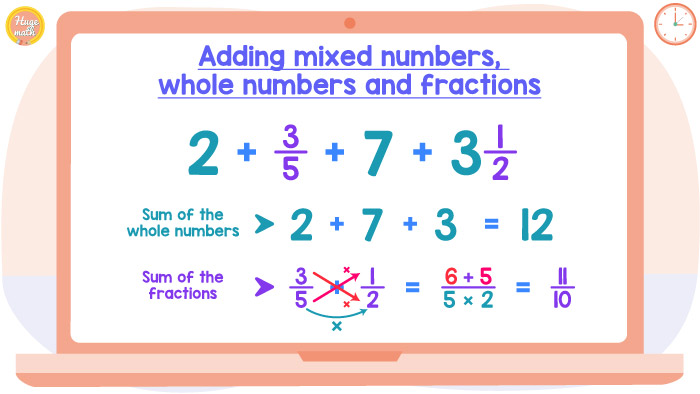
The sum of the fractions is an improper fraction. Since we don’t want an improper fraction in the final answer, we need to convert this improper fraction to a mixed number.

Lastly, we add the sum of the fractions to the sum of the whole numbers. If you want to, you can convert the resulting mixed number to an improper fraction.

Video
Let’s take a look at this examples.
In the next video, I will show you more examples.
References
For this lesson, we have used this book:
- Tussy, K., Gustafson, D. y Koenig, D. (2013). Prealgebra (4th ed.; pp. 374-378). Cengage Learning.