
Today we will take a look at how to subtract fractions from mixed numbers. Let’s see some examples.
Content:
Before getting started, don’t forget that a proper fraction is a fraction where the numerator (the top number) is less than the denominator (the bottom number). Also, a mixed number is the sum of a whole number and a proper fraction. See the image below.

1) Subtract 74/5 – 2/3:
The key to solve this problem is to remember that a mixed number is the sum of a whole number and a proper fraction. So first, we rewrite the mixed number 74/5 as the sum of the whole number 7 and the proper fraction 4/5.

Then, we find the difference of the fractions 4/5 and 2/3. These fractions have different denominators, so we need the least common multiple of the denominators or the least common denominator.

Given that the least common denominator is 15, for each fraction we need an equivalent fraction with a denominator of 15.

Then, we can find the difference of these fractions with like denominators, 12/15 and 10/15.

Lastly, we rewrite the sum of the whole number 7 and the proper fraction 2/15 as the mixed number 72/15.

The final answer is 72/15.
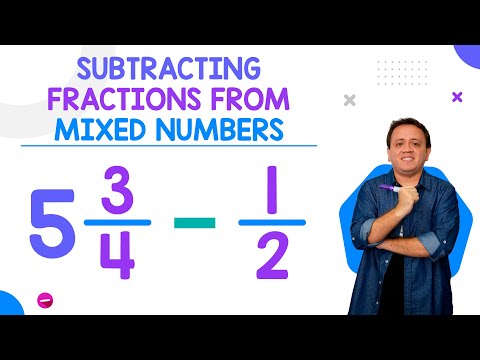
2) Subtract 53/4 – 1/2:
We start by rewriting the mixed number 53/4 as the sum of the whole number 5 and the proper fraction 3/4.

Then, we subtract the fractions 3/4 and 1/2. Since these fractions have different denominators, we need the least common denominator.

In the following step, for each fraction we need an equivalent fraction with a denominator of 4. The first fraction 3/4 already has a denominator of 4, so we don’t need to change that fraction. Then, we can subtract those 2 fractions (3/4 and 1/4) with like denominators.

Finally, we rewrite the sum of the whole number 5 and the proper fraction 1/4 as a mixed number.

The resulting mixed number is 51/4.
3) Subtract 91/6 – 1/3:
This time, we will work vertically. So first, we put the mixed number and below it the fraction.

Then, we subtract the fractions. Since they have different denominators, we need the least common denominator or the least common multiple of 6 and 3.

Next, for each fraction we need an equivalent fraction with a denominator of 6. The first fraction already has a denominator of 6, so we don’t need to readjust it.

Then, we can not subtract these 2 fractions, 1/6 and 2/6, because the second fraction, 2/6, is greater than the first one, 1/6.

We don’t have any other choice; we need to regroup. So, we rewrite 9 as 8 + 1.

We continue by rewriting 1 as the fraction 6/6.

Let’s start a new section on the right. Here we add the fractions 1/6 and 6/6.

Finally, to find the difference we start by subtracting the fractions (7/6 and 2/6) and we continue by subtracting the whole numbers (8 and 0).

The final answer is 85/6.
Videos
In the following video, we will walk through some examples of subtracting fractions from mixed numbers.

And here we have more examples.
Here comes another example with regrouping or carrying.

References
For this lesson, we have used these books:
- Tussy, K., Gustafson, D. y Koenig, D. (2013). Prealgebra (4th ed.; pp. 378-380). Cengage Learning.
- OpenStax (2020). Prealgebra 2e (pp. 374-376). Rice University.